
A Guide to Opportunity Class - NSW
28 May 2026
Opportunity Classes, often called OC classes, are special classes for high potential and gifted students in Years 5 and 6 in NSW public schools. Parents usually apply when their child is at the end of Year 3 or the beginning of Year 4, and students sit the placement test while they are in Year 4. The program runs for two years, from Year 5 to Year 6.
Key dates
The exact dates change each year, so parents should always check the NSW Department of Education website before applying. As a general guide, applications usually open around November, close around February, the test is normally held in early May, and placement outcomes are usually released around late September.
For Year 5 entry in 2027, the Opportunity Class Placement Test is scheduled for 8–9 May 2026, with students allocated to sit on one test day only. The make-up test is scheduled for 22 May 2026, and the last day to change school choices is 5 June 2026.
https://education.nsw.gov.au/schooling/parents-and-carers/choosing-a-school-setting/selective-high-schools/application-process
Test style
The OC Placement Test is now computer-based. Students complete the test on a computer provided by the department, usually at a local test centre. The test is made up of three sections: Reading, Mathematical Reasoning, and Thinking Skills. All questions are multiple choice and are answered on the computer.
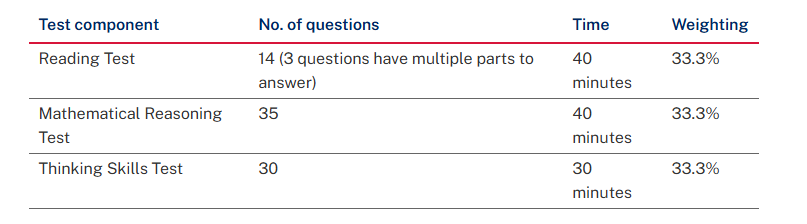
The test is designed to assess a student’s ability to read carefully, reason logically, solve problems, and apply what they already know. It is not a test where students need to memorise special facts or learn content far beyond the school curriculum.
The Reading section includes different types of texts, such as fiction, non-fiction, poetry, magazine-style articles and reports. Mathematical Reasoning focuses on applying maths knowledge to new problems, and calculators are not allowed. Thinking Skills tests critical thinking and problem-solving ability, with no previous topic knowledge required.
School choices
Parents can list up to 4 opportunity class school choices in their application. The first choice is required, and parents may add up to three more schools. However, families should only choose schools they would genuinely be happy for their child to attend.
School choice order matters. If a child qualifies for more than one school, the offer will usually be made for the highest eligible school listed in the family’s preferences.
https://education.nsw.gov.au/schooling/parents-and-carers/choosing-a-school-setting/selective-high-schools/choosing-a-school/opportunity-classes
Marking and placement
All OC test sections are multiple choice and computer-marked. Each subject contributes equally to the final test performance, with Reading, Mathematical Reasoning and Thinking Skills each weighted at 33.3%.
There is no fixed pass mark and no published minimum score for each school. The level required for an offer changes each year depending on the number of applicants, how students perform, the number of places available, and how many offers are declined.
Placement is based mainly on test performance and the order of school choices. Up to 20% of places at each school may also be held under the Equity Placement Model for students from under-represented groups, including students from low socio-educational advantage backgrounds, Aboriginal and/or Torres Strait Islander students, rural and remote students, and students with disability.
Understanding percentiles and performance bands
The performance report does not show a raw score, percentage mark, or exact placement rank. Instead, it shows how a child performed compared with other students who sat the test that year. For each test component, students are shown in one of four bands: top 10%, next 15%, next 25%, or lowest 50% of candidates.
This means a “top 10%” result is not the same as scoring 90%. It means the student’s result placed them in the top 10% of students who completed that test component. Similarly, being in the lower 50% does not mean the student failed; there is no pass or fail mark for the OC test.
https://education.nsw.gov.au/schooling/parents-and-carers/choosing-a-school-setting/selective-high-schools/outcomes
How to prepare for the OC test
Good preparation should focus on building confidence, accuracy and reasoning skills, rather than memorising large amounts of content.
For Reading, students should practise reading a variety of texts, including stories, poems, information texts and extracts. They should learn to identify main ideas, infer meaning, understand vocabulary in context, and pay close attention to wording in the questions.
For Mathematical Reasoning, students should practise problem-solving questions involving number, patterns, measurement, time, fractions, graphs, geometry and logic. The key is not just knowing maths rules, but knowing how to apply them in unfamiliar situations.
For Thinking Skills, students should practise logic puzzles, argument questions, pattern recognition, sequencing, “must be true” questions and questions that ask them to find mistakes in reasoning. This section rewards careful thinking and eliminating wrong answers.
Students can use Selective Journey to practise regularly in a test-style environment. The platform provides OC-style practice tests across Reading, Mathematical Reasoning and Thinking Skills, with timed conditions to help students build speed and confidence. After each test, students can review their answers, read the explanations, and understand why an option is correct or incorrect. This helps students learn from mistakes instead of simply moving on to the next test.
Regular practice on Selective Journey can also help students become familiar with different question types, improve time management, and track their progress over time. By repeating tests and reviewing explanations, students can gradually strengthen their reasoning skills and become more comfortable with the format of the OC test.
Final tips for parents
The OC test is competitive, and only a portion of students receive a place each year. NSW Education notes that around one in eight students are successful in gaining an opportunity class place.
Parents can support their child by encouraging consistent, low-pressure practice rather than last-minute cramming. A platform such as Selective Journey can make preparation easier by giving students access to structured practice tests, instant results, explanations, and progress tracking in one place.
It is also helpful for parents to review their child’s results and look for patterns. For example, a student may be strong in Reading but need more practice with Mathematical Reasoning or Thinking Skills. By using Selective Journey regularly, parents and students can identify weaker areas early and focus their preparation more effectively.
Most importantly, practice should help students feel more confident, not more stressed. Short, regular practice sessions, followed by careful review, can make a big difference over time.